
Environmental Assessment and Peer Review Update

September 2026 Update Below
Environmental Conditions in Draft Approval
There are four conditions in the draft plan of subdivision approval the proponent received from the Ontario Land Tribunal which outline the environmental requirements that the proponent must satisfy prior to the redevelopment of the site:
- A Record of Site Condition (RSC) under Ontario Regulation 153/04 which has been acknowledged by the MECP and confirms that the site is suitable for the proposed residential use;
- A remedial action plan to address soil contamination at the site;
- An updated Phase Two Environmental Site Assessment (ESA) with a remediation report appended that documents the remedial work completed at the site; and,
- A plan outlining control and mitigation measures for dust, odour, noise and sediment during all phases of excavation work.
The RSC requirement will ensure that the environmental site assessment and remediation work is conducted in accordance Ontario Regulation 153/04, to be overseen by a Qualified Person defined under the regulation and reviewed/approved by MECP’s technical staff.
Previous Environmental Site Assessments
The City of Ottawa has received two Phase One ESAs (dated 2018 and 2021) and three Phase Two ESAs (dated 2019, 2020 and 2021) completed by Paterson Group as part of the previous development applications for the site.
The 2021 Phase One ESA indicates that the site was historically vacant land, possibly used for agricultural purposes, prior to the development of the original 9-hole golf course in the late 1960s. Nine additional holes were added between 1976 and 1990. The Phase One ESA identified the aboveground fuel storage tanks and the storage and application of pesticides and herbicides as the two areas of potential environmental concern (APEC) at the site. No concerns regarding the surrounding properties were identified.
The most recent Phase Two ESA dated 2021 summarizes the various phases of field work completed at the site in 2019 and 2020. The 2019 investigation included advancement of 20 boreholes across the site, of which 13 were developed as monitoring wells, along with completion of 20 shallow hand auger holes. In 2020, an additional 34 shallow hand auger holes were advanced across the site in May 2020 and 24 further shallow hand auger holes completed in December 2020. Soil and groundwater samples collected as part of the ESAs were selectively analyzed for contaminants of concern depending on the area being investigated, and included benzene, toluene, ethylbenzene, and xylenes (BTEX), petroleum hydrocarbon fractions (PHCs), metals and/or pesticides.
The 2021 Phase Two ESA identified mercury in shallow soil samples across the site in excess of the applicable Ontario Ministry of Environment, Conservation and Parks (MECP) standard. The mercury is attributed to historical use of mercury-containing fungicides at the golf course which were used to control snow mold growth during the winter months. Although these fungicides were typically applied to putting greens, studies have indicated that elevated levels of mercury could extend up to 15 m from the putting surfaces where applied, or be present in other areas such as tee boxes or storage/maintenance yards. These types of mercury containing fungicides were generally discontinued from use in the 1990s.
In total, 74 soil samples collected across the site were analyzed for mercury as part of these initial studies and 15 samples, or approximately 20 per cent, exceeded the MECP standard for mercury. The maximum concentration of mercury measured at the site as part of the initial studies was 2.7 ug/g. Exceedances were not evenly distributed in soil across the golf course. The highest frequencies were observed in samples collected from the putting greens, where 69% of the 16 samples exceeded the standard, and at tee box areas where 50% of the 4 samples reported exceedances. In contrast, soil samples collected in the roughs, fairways, and other areas across the golf course had low or no exceedances. Most elevated results occurred in shallow soils (0–15 cm) with deeper samples showing no exceedances. Based on information provided to the City, the data indicates that not all greens have been investigated, and limited sampling has been completed at the tee boxes.
WSP’s Role as Independent Technical Advisor to the City
Given the significant public interest associated with the former Kanata Lakes golf course, the City has retained WSP Canada Inc. to provide independent technical advice beyond the City’s typical role in development review. WSP’s role is to:
- Review environmental submissions associated with specific Draft Plan Approval conditions;
- Assess whether proposed investigations, mitigation measures, and conclusions are consistent with recognized professional standards and industry best practices; and,
- Identify potential gaps, uncertainties, or risks that City staff may wish the proponent to address.
The third party review being undertaken WSP is not required under the draft approval conditions, but rather represents an additional commitment by the City to address community concerns. WSP’s peer reviews inform City staff’s oversight and help determine whether additional clarification or information should be requested from the proponent. WSP does not replace the proponent’s Qualified Person, does not direct on‑site work, and does not approve environmental investigations or provide regulatory sign‑off. The enhanced oversight approach, including the engagement of WSP, reflects the size and complexity of the site, the level of public interest, and the City’s desire to independently validate that development‑related environmental conditions are being addressed in a transparent and technically sound manner.
WSP Peer Review of 2021 Phase One/Two ESAs
The Paterson 2021 Phase One and Phase Two ESAs were peer-reviewed by WSP Canada Inc. in March 2026. The peer review was provided to the proponent for response and has also been posted to the Engage Ottawa page. WSP’s review of the previous environmental reports found numerous deficiencies which can be broadly grouped into the following categories:
1. Regulatory Compliance & Conformance to O. Reg. 153/04
The Phase One and Two ESA reports do not consistently conform to Ontario Regulation 153/04 requirements. Key issues include incorrect ESA terminology, incomplete adherence to the reporting requirements, missing mandatory elements (e.g., plan of survey, compliant figures), and report aging concerns. Updates will be required to support future filing of multiple Records of Site Condition (RSCs).
2. Site History & Study Area Definition
The Phase One ESA relies too heavily on distance‑based criteria to define the Study Area and excludes relevant lines of evidence. Historical land use documentation contains inaccuracies and omissions, including failure to recognize certain off‑site potentially contaminating activities (e.g., transformer station). Errors in land use tables reduce confidence in the identification of Areas of Potential Environmental Concern (APECs).
3. Natural Environment & Environmental Sensitivity
The assessment of Areas of Natural Significance is incomplete. Available provincial data indicate potential presence of threatened or endangered species, which may classify the Site as environmentally sensitive under O. Reg. 153/04. This has direct implications for the selection of applicable Site Condition Standards and Phase Two investigation requirements.
4. Physical Setting & Hydrogeological Understanding
Descriptions of geology, soils, groundwater, and well records are inconsistent or insufficiently substantiated. Soil pH and grain size data are inadequate to support selection of appropriate Site Condition Standards across the Site and future parcels.
5. Contaminants, PCAs & Conceptual Site Models
Conceptual Site Models are incomplete and internally inconsistent. Certain potentially contaminating activities (PCAs) and contaminants of potential concern (COPC) are not fully characterized, including fuel-related contaminants from aboveground storage tanks and historical herbicide use. Imported and reworked fill, sand traps, and relocated course features are not consistently addressed as potential APECs.
6. Mercury‑Specific Impacts
Mercury exceeds applicable Site Condition Standards at multiple shallow soil locations. The reports do not adequately recognize historical use of mercurial fungicides as a primary APEC, nor do they delineate the full lateral and vertical extent of mercury impacts. No methyl‑mercury analyses were completed, and consideration of historic green relocations and runoff pathways to the on-site water features is limited.
7. Sampling Design & Data Gaps
Sampling density and scope are insufficient in several areas, including soil pH, sediment within on‑site ponds, and characterization of reworked or imported materials. Contaminant migration pathways are not fully assessed, limiting confidence in overall site characterization and suitability for RSC filing.
8. QA/QC & Data Reliability
The number of field duplicate samples does not meet regulatory minimums, and quality assurance and quality control (QA/QC) sampling was not completed for all contaminants of potential concern. Some reported QA/QC metrics (e.g., relative percent differences or RPDs) are unclear or internally inconsistent, requiring additional sampling or clarification.
9. Figures, Tables & Reporting Quality
Figures and tables do not meet regulatory requirements and contain location errors, missing parameters, and insufficient labeling. Crosssections and contaminant distribution figures are limited, particularly given the need for multiple RSCs. Several internal inconsistencies and incomplete report sections were also identified.
While these concerns must be addressed prior to filing the RSCs with the MECP and prior to the City granting development approvals, they are not sufficient to immediately suspend engineering activities at the site. Based on the nature of the work occurring to date — namely, testing and investigation to address conditions of the draft subdivision approval the proponent received from the Ontario Land Tribunal — there is no violation of the Site Alteration By-law. As such, the City does not have the legal authority to issue a stop‑work order under the Act.
To satisfy the subdivision draft approval conditions and be compliant with provincial regulations, both ESA reports will require revision and supplementary Phase Two work. Key needs include additional sampling (mercury speciation, sediment, soil pH, QA/QC), refinement of conceptual site models, and improved documentation to support multiple RSC submissions. Updated Phase One and Two ESAs will be required by the proponent to obtain the Record of Site Condition(s) from the Ontario MECP which are necessary for the site redevelopment and a condition of the draft subdivision approval. The proponent is also required by the draft approval to submit their remediation plan to the City – determining the adequacy of this submission will be contingent on having an updated Phase Two ESA report outlining all of the soil and groundwater sampling data across the site. This will be another checkpoint at which the City and WSP will provide technical comments to the proponent on the adequacy of environmental site assessment work.
Proponent Response to WSP Peer Review
The environmental consultant retained by the proponent, Paterson Group, has prepared a response to the WSP peer review dated April 2, 2026. The Paterson memo acknowledges all of the WSP technical comments and confirms that the Phase One and Two ESA reports will be formally updated to fully meet Ontario Regulation 153/04 requirements before future Records of Site Condition (RSCs) are filed. The memo acknowledges that additional soil sampling and delineation (including analysis for methylmercury) will be required, and that report figures, mapping, and documentation will be enhanced to more clearly show sampling locations and site conditions. The following key items will be tracked by WSP and the City as the development application progresses:
- Deferral to Future RSC Filing – Although Paterson agrees with almost all technical comments, all substantive issues will be deferred to the future RSC filing. Until the future RSC filling is accepted by MECP, the current ESAs continue to remain inadequate for development approval.
- Environmental Sensitivity / Species at Risk - Paterson states they are investigating the possibility of Species at Risk within 30 m of future RSC parcels. The City will request to review the information and analysis collected by the proponent for this determination.
- Sediment vs. Soil Interpretation - Paterson technically agrees to sampling the water ponds at the site and reframes sediments as “soil” under O. Reg. 153/04 definitions, as they do not consider the ponds on the site to be “water bodies” as defined by the regulation (i.e., a permanent stream, river or similar watercourse or a pond or lake, but does not include a pond constructed on the property for the purpose of controlling surface water drainage). The underlying assumptions will be examined in detail upon receipt and assessment of additional study findings.
WSP is currently reviewing Paterson’s response and will advise the City if future discussions are warranted at this time. Overall, it is expected that additional soil sampling will be required to address data gaps as the developer works towards obtaining a Record of Site Condition for the redevelopment in accordance with the provincial legislation.
Submissions Related to Dust/Sediment Control
Condition 93 of the draft approval requires the developer to implement dust, sediment, noise and odour mitigation control measures during all phases of excavation work due to the presence of mercury contamination in the soils on-site. The following documents and correspondence related to these submissions are summarized below:
- The proponent’s consultant, Paterson Group, provided the City with a memo (dated February 13, 2026) outlining the proposed dust and sediment controls to be implemented during the preliminary engineering works which included: separation of proposed works from areas with known mercury exceedances; installation of silt fencing and sediment traps; use of mats at controlled exit points to prevent soil tracking onto roadways; and further testing of excavated soils in preliminary work areas with removal of any soil that exceeds provincial soil standards.
- WSP Canada Inc. completed a peer review of the Paterson memo (dated February 23, 2026) on behalf of the City and indicated that the proposed controls appeared reasonable given the known site conditions, however they recommended that documentation be prepared outlining how mitigation measures would be implemented and monitored, along with contingency measures in the event of a failure of any control measure. WSP also recommended development of a complaint tracking and response procedure, and a soil management plan.
- Paterson provided a response to WSP’s review (dated March 11, 2026), including submission of a Soil Management Plan (dated March 13, 2026) outlining how excess soil would be managed in accordance with Ontario Regulation 406/19, and the Environmental Protection Plan prepared by the contractor (Thomas Cavanagh Construction Ltd.) retained to complete the preliminary engineering works.
- WSP reviewed these additional submissions and provided some further comments to the proponent. Paterson provided two additional documents in response to the WSP comments, including a memorandum acknowledging the WSP comments (dated April 1, 2026), and an updated Soil Management Plan (dated April 1, 2026) with a revised figure showing the work areas. The Paterson response confirmed that the measures used to control soil tracking onto surrounding streets was working as intended, and that previous references to work on other parcels of the golf course had been removed, as the scope of the current works was revised to only Parcel 1.
The proponent has indicated in their most recent project update that the preliminary engineering works have been completed. All erosion and sediment control measures—including silt fencing and straw bales—will remain in place to ensure ongoing environmental protection. Regular site visits will be completed by the proponent to monitor stormwater flowing through the property and to ensure that all control measures remain effective. Any future phases of work will require a new submission outlining dust and sediment control measures to be implemented, which will be peer reviewed by WSP to ensure the proposed measures are appropriate for the site conditions, and in line with industry standards.
Recent Soil Testing Results
As part of the preliminary engineering works completed in March and April 2026, the proponent’s environmental consultant collected approximately 71 additional soil samples across the 12 work areas (pre-load pads, exfiltration manholes and bioswales). The proponent has provided the City with a preliminary summary of the soil sampling results, and indicated that mercury was detected in all but one of the 12 work areas. Overall, the measured mercury concentrations were within the range previously found at the site, and below the previous maximum mercury concentration of 2.7 micrograms per gram (µg/g). However, one area had one soil sample with a mercury concentration of 3.0 µg/g, with surrounding samples in the same area generally in the high 1.0 µg/g range.
All excavated material that exceeded the applicable site condition standards within the 12 work areas has been removed from the site to an appropriate licensed facility. The recent soil testing results will be summarized in a future Phase Two ESA report that remains a condition of the draft approval and a requirement under the Record of Site Condition.
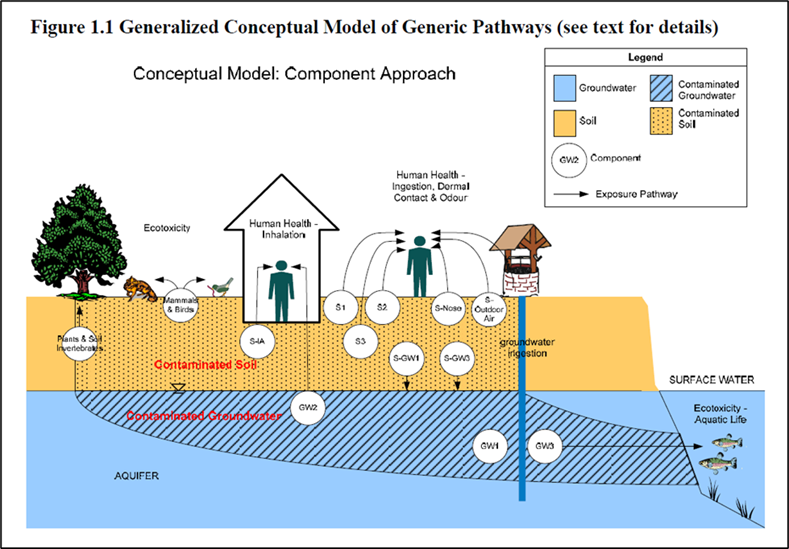
As previously summarized in the FAQ section, the Ontario Site Condition Standards used in evaluating contamination at a site were developed by evaluating all receptors and exposure pathways that may be present at a site including who might be exposed (for example, children, adults, wildlife) and how they might be exposed (touching soil, breathing vapours, plants taking up chemicals, etc.). For each contaminant, the province has calculated several “component values” - each one representing a safe level for a particular type of exposure and receptor. The lowest of these component values then becomes the generic standard for the contaminant for that particular land use, ensuring that human health and the environment are protected.
Under the applicable standard for this site (future residential/parkland use, coarse-textured soil, no potable groundwater use), the risk pathway that drives the mercury standard is vapour intrusion from soil into the indoor air of building (“S-IA” pathway on Figure 1.1 below). That pathway would normally give a component value of 0.25 µg/g, but the background level of mercury for Table 3 sites is 0.27 µg/g which is then established as the generic standard. Exceeding 0.27 µg/g means that the MECP and the City will require that mercury‑impacted soil be remediated prior to the development of future residential homes and public parks to protect future residents in this development.
Although the maximum mercury concentration of 3.0 µg/g measured at the site to date exceeds the MECP generic standard, this maximum concentration does not exceed any other component values developed for Table 3 residential/parkland sites:
- The soil contact (S1) component value is 9.8 ug/g - this is a high-frequency, high-intensity human health exposure scenario where children and pregnant women are present and includes soil ingestion and dermal exposure.
- The ecological component values are 10 ug/g for plants and soil organisms and 20 ug/g for mammals and birds.
- The component value for soil to outdoor air (S-OA) is 36 ug/g.
- The component value for soil to groundwater to surface water (S-GW3) is 1.2E+14 ug/g – this is a soil value that is protective of aquatic life.
Overall, the mercury levels identified at this site will require remediation for the proposed residential redevelopment; but remain below levels established for most receptors and exposure pathways at the site. Although there are still some data gaps with the environmental site assessment work completed at the site, the maximum mercury concentration measured to date does not suggest that there is significant risk to surrounding residents, plants or animals. As a precaution, the City required as a condition that the developer provide a plan to control dust and sediment during all phases of work to minimize the release of mercury into the environment.
Environmental Data for City-Owned Lands
In an effort to address community concerns about the broader potential environmental impacts in the residential neighbourhood surrounding the Kanata Lakes Golf Course, the City’s Environmental Remediation Unit (ERU) conducted a review of available environmental data for City-owned property in the vicinity of the golf course. Limited soil testing was previously completed in 2023 and 2024 at two nearby parks - Weslock Park at 73 Weslock Way and Sue Nickerson Park at 88 Knudson Drive - to support excess soil management during park improvements, in accordance with Ontario Regulation 406/19. At both sites, shallow soil samples were analyzed for metals parameters, including mercury, and no exceedances were identified.
The City will be initiating more comprehensive environmental site assessments at City-owned lands in this neighbourhood in the coming months. The first phase of work will include completion of Phase One ESAs for 7 surrounding park sites and shallow soil sampling along 8 pathway links to the golf course. Further updates will be posted to this Engage Ottawa webpage as the work progresses.
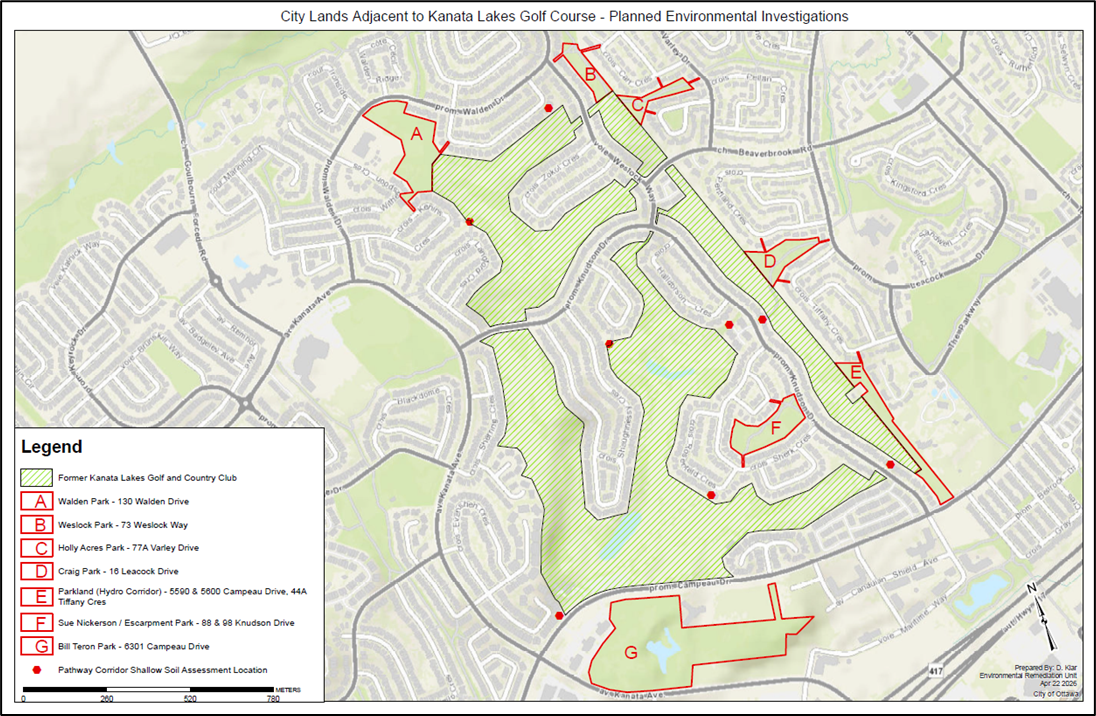
The following map shows the location of the seven City-owned parks adjacent to the Kanata Lakes Golf Course where Phase One ESAs will be initiated by the City this year (labelled A through G). The Phase One ESA is the first step in the environmental site assessment process, and involves a review of the current and historical activities on the site and surrounding properties (generally within a 250 metre radius of the site) to determine if there are potential and/or actual areas of environmental concern on the site. The Phase One ESA includes a review of regulatory and historical records, interviews with personnel knowledgeable about the site history and/or operations, along with completion of a site inspection. Phase Two ESAs will then be prioritized and completed on these City parks based on the findings and recommendations from the Phase One ESAs.
The City of Ottawa also owns eight smaller parcels of land that provide pathway connections to the golf course (shown as red dots on the map). Due to their small size, Phase One ESAs will not be completed on these parcels, but instead shallow soil samples will be collected to investigate whether there may be a broader concern with mercury impacts beyond the limits of the golf course property.
UPDATE - City of Ottawa Testing and Assessment
The proponent and its consultant are undertaking environmental investigations as part of the proposed redevelopment. As part of the City's independent review of that work, staff requested permission for WSP Canada Inc. to collect duplicate soil samples alongside those collected by Paterson Group to independently verify the results. The property owner allowed WSP to observe and monitor the soil sampling activities but did not grant permission to collect third-party soil samples.
The City of Ottawa's Sewer Use Program also conducted multiple inspections and stormwater sampling events at and around the Kanata Lakes Golf Course between March and April 2026 in response to resident concerns about potential mercury contamination, stormwater discharges, and drainage impacts. Three stormwater samples were collected and analyzed, including a sample at the point where the golf course's private stormwater system enters City infrastructure. All laboratory results showed mercury concentrations below the laboratory detection limit of 0.1 ug/L and within the requirements of the City’s Sewer Use By-law. No evidence of illicit discharges, dewatering activities, or Sewer Use By-law violations was found during the inspections.
September 2026 UPDATE - Testing in City-owned Lands
In an effort to address community concerns about the broader potential environmental impacts in the residential neighbourhood surrounding the Kanata Lakes Golf Course, the City’s Environmental Remediation Unit retained WSP Canada Inc. to conduct surface soil sampling along eight City-owned pathways that connect surrounding neighbourhoods to the former golf course. The resulting Kanata Lakes Pathway Soil Sampling Report[link] is posted on this Engage Ottawa webpage within the City of Ottawa Documents section. The investigation was undertaken in response to mercury contamination identified on portions of the golf course, which is attributed to the past use of mercurial fungicides.
In addition to the shallow soil sampling program along City-owned pathways, the City has also initiated more comprehensive environmental site assessments (ESAs) at seven City-owned parks surrounding the golf course. The first phase of work involves completion of Phase One ESAs which are expected to be completed in the fall. Further updates will be posted to this Engage Ottawa webpage once the Phase One ESAs are completed.
Shallow soil samples collected from 35 sampling locations were assessed and analyzed for mercury and other metals of potential environmental concern. Results showed that mercury was detected at low levels in all samples, but all concentrations were well below applicable Ontario Ministry of the Environment, Conservation and Parks standards for residential and parkland uses. With the exception of a single exceedance of the available boron standard at one location, which is attributed to naturally occurring organic matter and is not considered a public health concern, all analyzed parameters met applicable standards. The study concluded that historical golf course activities have not resulted in contamination of shallow soils on the City-owned pathways, and no unacceptable risks to pathway users are anticipated.

Thank you for your contribution!
Help us reach out to more people in the community
Share this with family and friends