Rental Renovation Licence By-law Review
Consultation has concluded
Update #6: July 22, 2026
On 15 July 2026, City Council approved a new Rental Renovation Licence By-law (“Renovictions By-law”) to come into force on 1 January 2027.
Under the new rules, landlords seeking to evict a tenant for renovation or repair work will be required to:
- Get a building permit for the work before issuing the eviction notice,
- Provide the tenant with a City-produced eviction education guide alongside the eviction notice, and
- Apply to the City of Ottawa for a licence to conduct the work within 7 days of issuing the eviction notice to the tenant. To obtain this licence, landlords must:
- provide information about the tenancy and scope of work,
- confirm that they delivered the education guide to their tenant,
- provide a copy of the N13 eviction notice, and
- provide the building permit number obtained for the work.
This by-law does not replace the provincial eviction process, and landlords must continue to seek an eviction order from the Landlord and Tenant Board when required.
The by-law and staff report can be found here or in the Documents section of this page.
Next steps
Over the coming months, staff will be developing the new licensing program, including the eviction education guide.
On 15 July 2026, City Council also directed staff to consider a review of the Rental Renovation Licence By-law on the next Term of Council By-law Review Work Plan. Should Council approve this review as part of next Term’s Work Plan, staff have been directed to consider:
- a requirement for a qualified person’s report to confirm vacant possession is necessary,
- a requirement for landlords to provide temporary accommodations to tenants (either in the form of an alternate unit or financial compensation) for the duration of the work,
- data trends relating to provincial N5 and N12 eviction notices,
- data related to building permit and rental renovation licence timelines, including factors that could cause delays, incomplete or non-compliant applications, and
- data on the number of licence applications received, licences issued, enforcement actions, repeat applications for the same properties or landlords, operating costs, privacy impacts, interaction with the strengthened provincial framework, and any evidence that the by-law has reduced unlawful renovation or repair related evictions.
Should you have any questions or wish to provide feedback please contact us.
Thank you for your interest and participation throughout this process.
Update #5: June 29, 2026
The Rental Renovation Licence By-law report and draft by-law are now posted here. It will be considered by Planning and Housing Committee on July 8, 2026 and City Council on July 15, 2026.
The recommended by-law requires landlords seeking an eviction for renovations or repairs to apply to the City of Ottawa for a licence to conduct the work within seven days of issuing the tenant the eviction notice.
To be issued the licence, landlords would be required to:
- obtain their building permit beforehand,
- provide the City with a copy of the eviction notice,
- provide their tenant with an eviction education guide produced by the City alongside the eviction notice, and
- provide information related to the rental unit.
How to participate
Committees are broadcasted on YouTube through City Council's YouTube channel and can be found here. If you would like to join as a delegate to speak or present at Committee, you must register in advance. Please find the contact information for the Committee Coordinator below to request to be a delegate. In addition, you can find more information on how to get involved in Council and Committee proceedings here: Get involved in local government | City of Ottawa.
Planning and Housing Committee Coordinator Information:
Kelly Crozier
(613) 580-2424, ext. 16875
Kelly.Crozier@ottawa.ca
If you have any questions, please contact us.
Update #4: June 16, 2026
At the Planning and Housing Committee meeting on June 3, 2026, staff provided an information report updating the Committee on the changes to the Residential Tenancies Act, which were proclaimed by the province on April 16, 2026. Staff sought direction from Council on how to proceed in light of this change to the status of the provincial amendments. Committee approved a direction to staff to bring forward the Rental Renovation License By-law report and a draft-bylaw to the meeting of Planning and Housing Committee scheduled for July 8, 2026.
We sincerely appreciate the time and interest you have contributed to this review to date. Further information will be posted here once the agenda for the July 8 meeting of Planning and Housing Committee is published, at which time a link to the report and draft by-law will be made available
If you have any questions in the meanwhile, please do not hesitate to contact us.
Update #3: May 26, 2026
On June 3, 2026, staff will be presenting an information report on the Rental Renovation Licence By-law Review and recent changes to the Residential Tenancies Act, 2006 to the Planning and Housing Committee. A link to the report can be viewed here.
A series of provincial amendments to the Residential Tenancies Act, 2006, as passed under Bills 97 and 60, were recently proclaimed into force by the Province of Ontario for later this year under Orders in Council 616/2026, 617/2026 and 618/2026. As per Council’s direction (refer to Document 1 here), staff are reporting back to provide an update and so that Council may direct staff on whether to proceed with the by-law review or to rely on the strengthened provincial framework.
These provincial amendments strengthen tenant protections for renovation or repair related evictions by introducing new mandatory timeline estimates, notification when the work is completed, and a minimum of 60 days for the tenant to return to their rental after work is completed. These amendments also introduce the automatic assumption that a landlord has failed to afford the tenant’s right to return if the landlord does not follow these requirements, and it doubles maximum fines for offences to up to $100,000 for individuals and $500,000 for corporations.
Update #2: February 5, 2026
Thank you to all who provided comments and feedback as part of the questionnaire. A “What We Learned” report that summarizes this feedback is now posted to the Documents section on the right-hand side of this page.
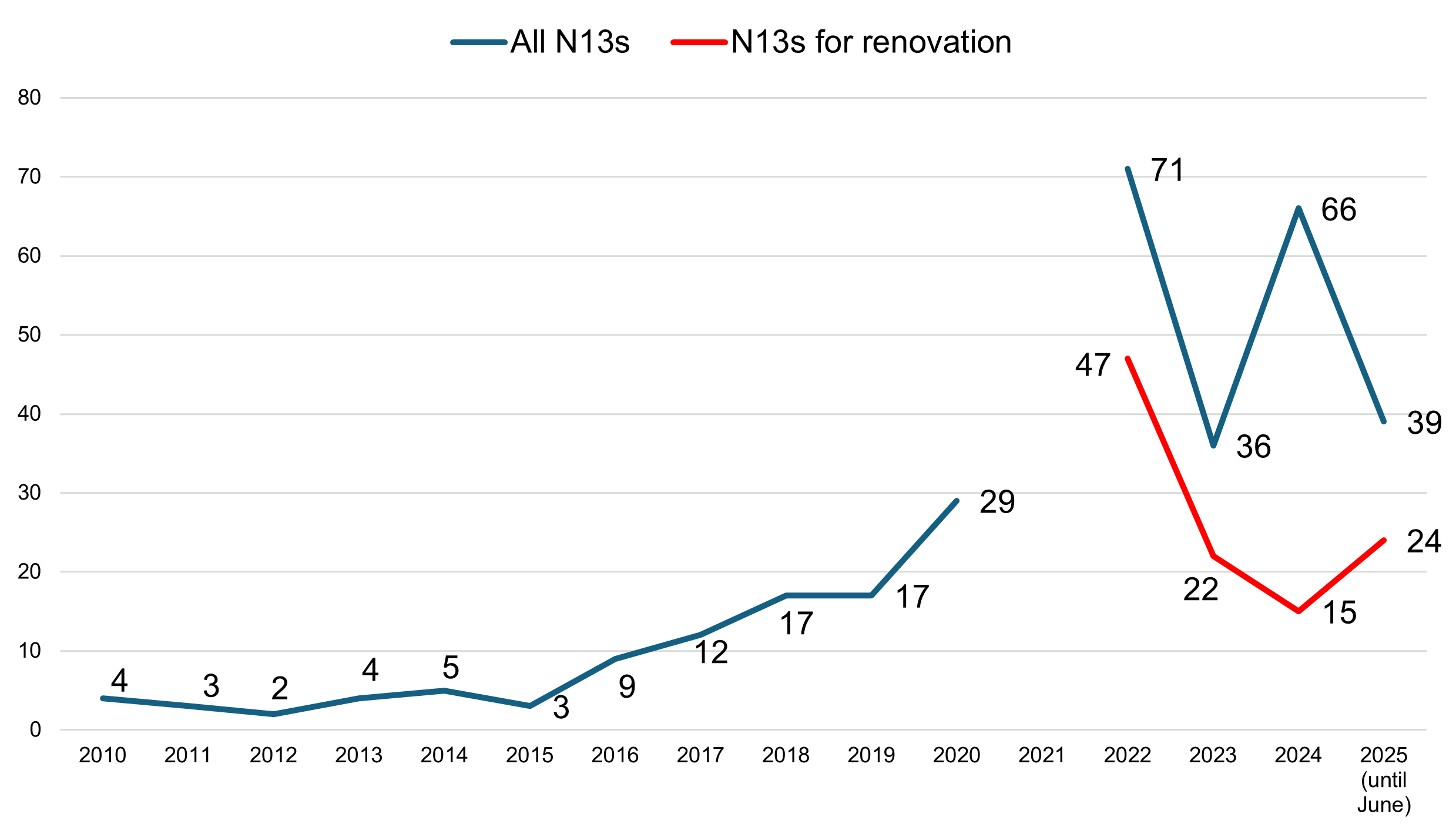
An overview quantifying the number of evictions related to renovations or repairs that staff are aware of to date has also been posted to the News Feed section at the bottom of this page.
Update #1: September 15, 2025
A survey has now been posted to gather feedback on your experiences with evictions for renovation and repair in Ottawa and on potential regulations and measures under consideration for this review. This survey will take up to 15 minutes to complete and will remain open until 31 October 2025.
Please also visit the Engagement Opportunities section of this page to learn more about how else you may participate and provide feedback this month.
The City of Ottawa is considering a Rental Renovation Licence By-law, also known as a “Renovictions” By-law.
What are “renovictions”?
The term “renovictions” refers to evictions that occur when a landlord renovates or repairs a rental property and replaces the evicted tenant(s) with those who would pay higher rent after the renovations are completed, failing to meet the legislated requirements to let the tenant move back in. As opposed to legitimate evictions requiring vacancy for renovations or repairs, “renovictions” cause a concern that the eviction is occurring in bad faith and being used to illegally end the tenancy.
Landlord and tenant rights under the Residential Tenancies Act, 2006
In the Province of Ontario, the Residential Tenancies Act governs the relationship between landlords and tenants, including how evictions from rental units can occur legally. Such evictions are legal when a landlord wishes to make repairs or renovations to a rental unit and the scope of work may require a building permit and requires vacant possession of the unit.
In these cases, the landlord must issue an N13 form to the tenant, also known as a “Notice to end your Tenancy Because the Landlord Wants to Demolish the Rental Unit, Repair it or Convert it to Another Use.” This process outlines the rights and responsibilities of both landlords and tenants:
- The landlord must provide the tenant with at least 120 days’ notice
- After the renovations are complete, the tenant has the option to move back into the renovated unit provided the tenant gave prior notice in writing. This is known as the right of first refusal
- The landlord cannot increase the rent by more than what could lawfully have been charged if there was no interruption to the tenancy
- The tenant who wants to reoccupy the renovated unit is entitled to compensation while the unit is being renovated. That compensation is the lesser of either one to three months’ rent (depending on the size of the residential building) or equal to the rent for the time that the renovations are occurring. The landlord must also offer the tenant another rental unit that is acceptable to the tenant
- The tenant who does not want to reoccupy the renovated unit is entitled to either the compensation of one to three months’ rent (depending on the size of the residential building) or to a comparable rental unit
Addressing and resolving disputes between landlords and tenants about evictions are in the exclusive jurisdiction of the Landlord and Tenant Board. Municipalities like the City of Ottawa cannot stop an eviction from occurring but can work to ensure that both landlords and tenants are aware of their rights.
What the City of Ottawa is reviewing
Staff will be reviewing the creation of a by-law in Ottawa that considers:
- The scope and impact of unlawful evictions for renovations and repairs in Ottawa and potential mitigations that are within the City’s authority
- The approaches taken in other jurisdictions to address such unlawful evictions
- Any existing or planned legislation, programs, and services in other levels of government and how they might work with a by-law
Engagement opportunities
The City of Ottawa is refreshing its 10-Year Housing and Homelessness Plan. Three in-person Open Houses will take place at various locations across the city in the month of September. Our review team will be part of this broader discussion and we encourage you to visit our booth to learn more about our Rental Renovation License By-law Review and to provide us with your feedback and comments. The Open Houses are drop-in style, with no registration required.
- Wednesday, September 17, 6 to 8pm at Jim Durrell Recreation Centre
- Thursday, September 18, 6 to 8pm at Tom Brown Arena
- Thursday, September 25, 4:30 to 6:30pm at CardelRec Recreation Centre
For more information on the 10-Year Housing and Homelessness Plan refresh, please visit 10-Year Housing and Homelessness Plan Refresh | Engage Ottawa.
Landlord and tenant supports
Please note that while we seek and welcome your feedback, including your lived experiences with past or current evictions for renovations or repair, Public Policy Development Services staff are not best positioned to assist you with any questions related to the N13 process or for any general inquiries related to the Residential Tenancies Act.
Please visit the following links, and the important links section of this page, for guidance on where to best direct your inquiries:
- For more information about tenant rights and supports within the City of Ottawa, please visit Tenants rights and supports | City of Ottawa
- For more information about landlord roles and responsibilities, including an extensive list of additional resources, please visit Landlords - roles and responsibilities | City of Ottawa or Help for Small Landlords - Landlord's Self Help Centre
- For more information about the Residential Tenancies Act, please visit Solve a disagreement with your landlord or tenant | ontario.ca
- For more information about the Landlord Tenant Board, including how to contact them, please visit Landlord and Tenant Board - Tribunals Ontario
-
Quantifying evictions for renovations
Share Quantifying evictions for renovations on Facebook Share Quantifying evictions for renovations on X (formerly Twitter) Share Quantifying evictions for renovations on Linkedin Email Quantifying evictions for renovations linkConsultation has concludedIn Ontario, the Residential Tenancies Act governs the relationship between landlords and tenants, including the process for evictions related to renovations or repairs. As a first step in this process, landlords issue tenants an N13 eviction notice, also known as a “Notice to end your Tenancy Because the Landlord Wants to Demolish the Rental Unit, Repair it or Convert it to Another Use.”
N13 eviction notices are used for three reasons:
- Demolition of a property
- Renovations or repairs of a property that require vacant access
- Conversion of a property to a non-residential use
To obtain an order ending the tenancy,Continue reading