Bank Street Heritage Conservation District Plan

Share Bank Street Heritage Conservation District Plan on Facebook Share Bank Street Heritage Conservation District Plan on X (formerly Twitter) Share Bank Street Heritage Conservation District Plan on Linkedin Email Bank Street Heritage Conservation District Plan link

Background

The Ontario Heritage Act allows municipalities to recognize and protect neighbourhoods, main streets, and other areas of special and cohesive cultural heritage value.

The Bank Street Heritage Conservation District (HCD) was designated in 2000 through By-law 175-2000. At the time of its adoption, Council adopted guidelines to inform changes in the District, as there was no requirement for a formal management plan.

Since 2005, the Ontario Heritage Act has required that municipalities prepare Heritage Conservation District Plans for new Heritage Conservation Districts. It also enabled municipalities to prepare plans for Districts that were designated before 2005.

Several other Districts were designated without plans, and the City has been working to create these plans over time.

Creating a plan for the Bank Street Heritage Conservation District will:

  • Set clear expectations for property owners, architects, and developers
  • Help guide future changes so they respect the district’s heritage
  • Describe the district’s cultural heritage values and significance
  • Provide policies and guidelines to support the plan’s objectives

Project Overview

In 2024, City Council directed staff to create an HCD Plan for the Bank Street Heritage Conservation District.

Key Deliverables:

  • Historical, contextual and architectural summary of the study area based on previous studies, including the 1999 Central Area West Heritage Conservation District Study
  • An updated heritage inventory and evaluation of properties located within the Bank Street Heritage Conservation District Study Area
  • A Heritage Conservation District Plan that meets the requirements outlined in the Ontario Heritage Act.

What is a Heritage Conservation District?

Under Part V of the Ontario Heritage Act, municipalities can designate areas of special cultural heritage value that have a cohesive sense of time and place. These areas often include:

  • A group of historic buildings, sites, or landscapes
  • A consistent look and feel, with similar building sizes, styles, materials, and colours
  • A unique character that distinguishes them from surrounding areas

District designation allows municipalities to manage and guide future changes through a formal plan. This plan includes policies and guidelines to conserve and enhance the district’s special character.

What will district designation mean to me?

The Bank Street Heritage Conservation District is already designated. This means that the rules and regulations for making changes to properties in the District already apply. The new Plan will update and clarify the rules that apply to properties within the District.

This study will not change the boundaries of the District.

If you own a property in the District:

  • Minor changes to the exterior (like replacing windows or modifications to storefronts) typically require a heritage permit. These are usually reviewed and by City staff in 5 to 10 business days.
  • Major changes (such as large renovations or new construction, or demolition) require consideration by the Built Heritage Committee and City Council. Council may approve, deny, or approve with conditions.
  • Demolition is generally not supported except in extraordinary circumstances and must receive approval from City Council.
  • Interior changes are not regulated by the heritage designation.

Heritage designation is not intended to prevent change, but rather to ensure that changes respect and enhance the district’s historic character.

Study area

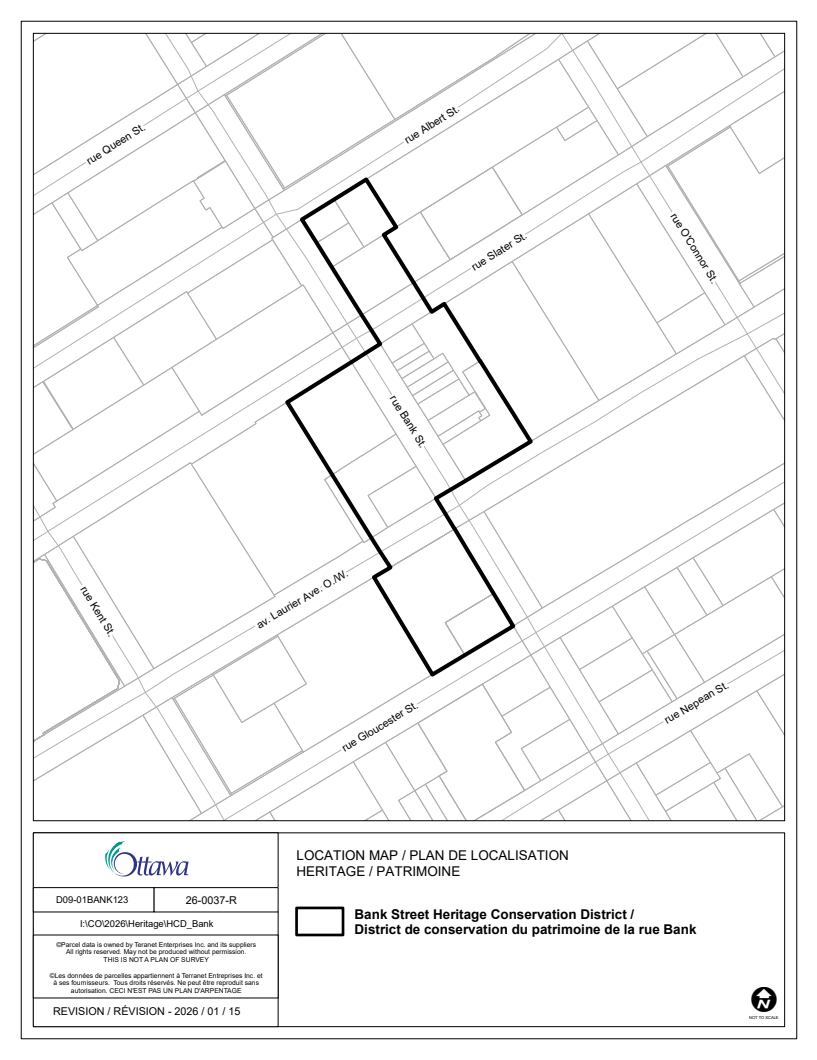
The Bank Street Heritage Conservation District is centred along Bank Street, and extends north-south from Albert Street to Gloucester Street. It includes the east side of the Albert to Slater block, both sides of the Slater to Laurier Avenue West block, as well as the west side of the Laurier Avenue West to Gloucester block. The area is intrinsically connected to Parliament and its operations to the north, and commercial-residential functions to the south in the Centretown Heritage Conservation District.

The area mainly includes commercial buildings from the late 1800s and early 1900s. These buildings typically have flat roofs, are two to five storeys tall, and demonstrate early examples of main street architecture. Many of them feature styles known as Italianate and Queen Anne, which were popular for commercial buildings in Canada at the time. The buildings were crafted with great skill and detail, thanks to the expansion of the national capital and access to high-quality materials.

Originally, the ground floors were used for shops and businesses. Over time, these storefronts have changed to suit new tenants, but many original design features remain. These include consistent building heights and setbacks, recessed doorways, and patterns in windows, doors, and decorative details. Together, these buildings create a unified and historic streetscape, with a steady rhythm and strong visual connection, especially at the corners where anchor buildings stand out.
Background

The Ontario Heritage Act allows municipalities to recognize and protect neighbourhoods, main streets, and other areas of special and cohesive cultural heritage value.

The Bank Street Heritage Conservation District (HCD) was designated in 2000 through By-law 175-2000. At the time of its adoption, Council adopted guidelines to inform changes in the District, as there was no requirement for a formal management plan.

Since 2005, the Ontario Heritage Act has required that municipalities prepare Heritage Conservation District Plans for new Heritage Conservation Districts. It also enabled municipalities to prepare plans for Districts that were designated before 2005.

Several other Districts were designated without plans, and the City has been working to create these plans over time.

Creating a plan for the Bank Street Heritage Conservation District will:

  • Set clear expectations for property owners, architects, and developers
  • Help guide future changes so they respect the district’s heritage
  • Describe the district’s cultural heritage values and significance
  • Provide policies and guidelines to support the plan’s objectives

Project Overview

In 2024, City Council directed staff to create an HCD Plan for the Bank Street Heritage Conservation District.

Key Deliverables:

  • Historical, contextual and architectural summary of the study area based on previous studies, including the 1999 Central Area West Heritage Conservation District Study
  • An updated heritage inventory and evaluation of properties located within the Bank Street Heritage Conservation District Study Area
  • A Heritage Conservation District Plan that meets the requirements outlined in the Ontario Heritage Act.

What is a Heritage Conservation District?

Under Part V of the Ontario Heritage Act, municipalities can designate areas of special cultural heritage value that have a cohesive sense of time and place. These areas often include:

  • A group of historic buildings, sites, or landscapes
  • A consistent look and feel, with similar building sizes, styles, materials, and colours
  • A unique character that distinguishes them from surrounding areas

District designation allows municipalities to manage and guide future changes through a formal plan. This plan includes policies and guidelines to conserve and enhance the district’s special character.

What will district designation mean to me?

The Bank Street Heritage Conservation District is already designated. This means that the rules and regulations for making changes to properties in the District already apply. The new Plan will update and clarify the rules that apply to properties within the District.

This study will not change the boundaries of the District.

If you own a property in the District:

  • Minor changes to the exterior (like replacing windows or modifications to storefronts) typically require a heritage permit. These are usually reviewed and by City staff in 5 to 10 business days.
  • Major changes (such as large renovations or new construction, or demolition) require consideration by the Built Heritage Committee and City Council. Council may approve, deny, or approve with conditions.
  • Demolition is generally not supported except in extraordinary circumstances and must receive approval from City Council.
  • Interior changes are not regulated by the heritage designation.

Heritage designation is not intended to prevent change, but rather to ensure that changes respect and enhance the district’s historic character.

Study area

The Bank Street Heritage Conservation District is centred along Bank Street, and extends north-south from Albert Street to Gloucester Street. It includes the east side of the Albert to Slater block, both sides of the Slater to Laurier Avenue West block, as well as the west side of the Laurier Avenue West to Gloucester block. The area is intrinsically connected to Parliament and its operations to the north, and commercial-residential functions to the south in the Centretown Heritage Conservation District.

The area mainly includes commercial buildings from the late 1800s and early 1900s. These buildings typically have flat roofs, are two to five storeys tall, and demonstrate early examples of main street architecture. Many of them feature styles known as Italianate and Queen Anne, which were popular for commercial buildings in Canada at the time. The buildings were crafted with great skill and detail, thanks to the expansion of the national capital and access to high-quality materials.

Originally, the ground floors were used for shops and businesses. Over time, these storefronts have changed to suit new tenants, but many original design features remain. These include consistent building heights and setbacks, recessed doorways, and patterns in windows, doors, and decorative details. Together, these buildings create a unified and historic streetscape, with a steady rhythm and strong visual connection, especially at the corners where anchor buildings stand out.

  • Approval of Bank Street Heritage Conservation District (HCD) Plan

    Share Approval of Bank Street Heritage Conservation District (HCD) Plan on Facebook Share Approval of Bank Street Heritage Conservation District (HCD) Plan on X (formerly Twitter) Share Approval of Bank Street Heritage Conservation District (HCD) Plan on Linkedin Email Approval of Bank Street Heritage Conservation District (HCD) Plan link

    July 10, 2026

    City Council, at its meeting held on Wednesday, June 24, 2026, passed By-law 2026-288 to adopt the Heritage Conservation District Plan for the Bank Street Heritage Conservation District.

    Notice of the passage of the above-noted by-law will be published online at Ottawa.ca/heritagenotices on July 10, 2026.

    Section 41 (4) of the Ontario Heritage Act establishes that any person who wishes to object to the passing of this by-law may do so by appeal to the Ontario Land Tribunal by giving the Tribunal and the Clerk of the City of Ottawa, within 30 days after the online publication of this notice, a notice of appeal setting out the objection to the by-law and the reasons in support of the objection, accompanied by the filing fee charged by the Ontario Land Tribunal (see below).

    The notice of appeal can be submitted via email to:
    CityClerk-HeritageObjections@ottawa.ca. The notice of appeal can also be submitted via registered mail or be delivered in person, by appointment, at the following coordinates:

    Caitlin Salter MacDonald, City Clerk c/o Christopher Zwierzchowski, Committee Coordinator 110 Laurier Avenue West, Ottawa, Ontario K1P 1J1,
    mail code 01-71

    Please contact Christopher Zwierzchowski, Committee Coordinator, at (613) 580-2424, ext. 27005, or Christopher.Zwierzchowski@ottawa.ca.

    Should a notice of appeal be received, the Council of the City of Ottawa will refer the matter to the Ontario Land Tribunal for a hearing. A filing fee must accompany the appeal letter. For more information on the applicable filing fee, please visit olt.gov.on.ca/appeals-process/fee-chart/.

    If no appeals are given, the HCD Plan will come into force on August 10, 2026.

    If you would like a copy of the HCD Plan, please contact Ben Morin. The final plan, in French and English, will be posted on the City of Ottawa website after the expiration of the appeal period. If appeals are received, the plan will be posted after the appeals are heard.

    Should any other information be required, you may contact Ben Morin directly at 613-580-2424, ext. 23172, or Ben.Morin@ottawa.ca.

    July 10, 2026

    City Council, at its meeting held on Wednesday, June 24, 2026, passed By-law 2026-288 to adopt the Heritage Conservation District Plan for the Bank Street Heritage Conservation District.

    Notice of the passage of the above-noted by-law will be published online at Ottawa.ca/heritagenotices on July 10, 2026.

    Section 41 (4) of the Ontario Heritage Act establishes that any person who wishes to object to the passing of this by-law may do so by appeal to the Ontario Land Tribunal by giving the Tribunal and the Clerk of the City of Ottawa, within 30 days after the online publication of this notice, a notice of appeal setting out the objection to the by-law and the reasons in support of the objection, accompanied by the filing fee charged by the Ontario Land Tribunal (see below).

    The notice of appeal can be submitted via email to:
    CityClerk-HeritageObjections@ottawa.ca. The notice of appeal can also be submitted via registered mail or be delivered in person, by appointment, at the following coordinates:

    Caitlin Salter MacDonald, City Clerk c/o Christopher Zwierzchowski, Committee Coordinator 110 Laurier Avenue West, Ottawa, Ontario K1P 1J1,
    mail code 01-71

    Please contact Christopher Zwierzchowski, Committee Coordinator, at (613) 580-2424, ext. 27005, or Christopher.Zwierzchowski@ottawa.ca.

    Should a notice of appeal be received, the Council of the City of Ottawa will refer the matter to the Ontario Land Tribunal for a hearing. A filing fee must accompany the appeal letter. For more information on the applicable filing fee, please visit olt.gov.on.ca/appeals-process/fee-chart/.

    If no appeals are given, the HCD Plan will come into force on August 10, 2026.

    If you would like a copy of the HCD Plan, please contact Ben Morin. The final plan, in French and English, will be posted on the City of Ottawa website after the expiration of the appeal period. If appeals are received, the plan will be posted after the appeals are heard.

    Should any other information be required, you may contact Ben Morin directly at 613-580-2424, ext. 23172, or Ben.Morin@ottawa.ca.

Page last updated: 10 Jul 2026, 08:45 AM